







How to Optimize Your WordPress Site for AI Search & Google AI Overviews (2026)
Learn how to optimize your WordPress site for AI search and Google AI Overviews in 2026 — structure, schema, and formatting tips that get you cited.

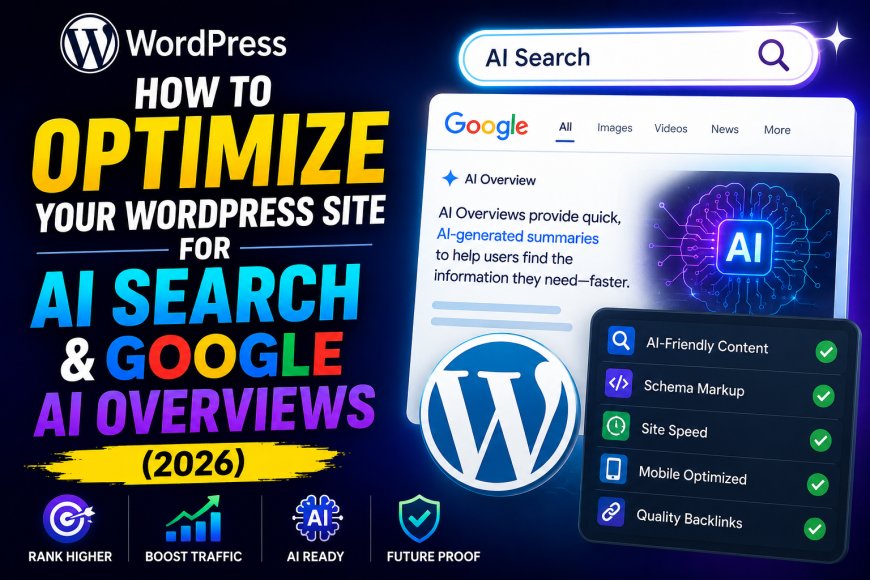
Search has quietly changed. A growing share of Google searches now end without a single click — the answer appears directly in an AI Overview, and the searcher never visits a website at all. Google's AI Mode has already passed 1 billion monthly users. For WordPress site owners, this isn't a future problem to prepare for — it's already reshaping how traffic works right now. This guide covers exactly how to structure your WordPress content so AI search engines can understand it, trust it, and cite it.
Why AI Search Is Changing Everything
Recent clickstream data shows a majority of Google searches in the US now end without any click at all. That doesn't mean SEO is dead — it means the goal has shifted. Instead of optimizing purely for a click, sites now need to optimize for being the answer — the source an AI system chooses to cite or summarize.
Interestingly, this doesn't remove the value of ranking well. Research shows that for important topics — things like health or money — a large share of users still click through to double-check an AI-generated answer "just to be sure." That means the click that remains is often more valuable and more intent-driven than before, and being the cited source dramatically increases your odds of capturing it.
How AI Search Actually Reads Your Content
AI search systems don't just match keywords the way traditional search did. They evaluate:
- Whether your content directly and clearly answers the query
- How your content is structured (headings, sections, logical flow)
- Whether related topics on your site reinforce each other (topical authority)
- Technical signals like site speed and structured data
In short: AI search is less about exact-match phrases and more about whether a page genuinely, clearly answers the question — organized in a way that's easy for a machine to parse and trust.
Structure Your Posts for AI (Answer-First Formatting)
A strong AI-search-ready WordPress post typically includes:
- A specific, descriptive H1 and clear H2 subheadings
- A direct answer to the core question near the top of the post, not buried after several paragraphs of introduction
- Short paragraphs with minimal filler
- Bullet points for key takeaways and lists
- Tables for comparisons
This isn't just good for AI — it's good for human readers scanning on mobile too, which is exactly why this formatting style works for both audiences at once.
Use Schema Markup That AI Engines Rely On
Structured data (schema markup) helps both traditional search engines and AI systems understand exactly what your content is and how it's organized. On WordPress, most SEO plugins (Yoast, Rank Math, All in One SEO) can add this automatically, but it's worth confirming these types are active where relevant:
- Article schema — for blog posts and guides
- FAQ schema — for question-and-answer sections like the one at the end of this post
- HowTo schema — for step-by-step tutorials
- Author schema — helps establish expertise and trust signals
- Organization schema — establishes your site's identity clearly
Internal Linking for Topical Authority
AI systems look at how the different pages on your site connect to each other. If you write about WordPress security, for example, having related posts on login protection, malware scanning, firewalls, and backups — all linked together — signals depth and authority on the topic, not just a single isolated article.
When linking internally, use descriptive anchor text like "WordPress schema markup guide" instead of vague phrases like "click here" — this helps both readers and AI systems understand what the linked page is actually about before they click.
Speed and Core Web Vitals Still Matter
AI search hasn't made technical SEO irrelevant — if anything, it raises the bar. A slow WordPress site is harder to crawl efficiently and creates a worse experience for the share of users who do click through. Prioritize:
- Fast hosting and caching
- Optimized, compressed images
- A lightweight, well-coded theme rather than a bloated all-in-one page builder
- Mobile-friendliness — a large share of AI search traffic comes from mobile devices, so a site that isn't mobile-optimized misses a significant opportunity
Getting Cited vs. Getting Clicked
When your content is split across multiple competing URLs on your own site — say, both a post and a near-duplicate category archive — AI systems face the same challenge Google does: they struggle to identify which is the definitive source. This is one more reason why cleaning up duplicate content (category and tag archive issues in particular) has become more urgent in 2026 than in previous years — it doesn't just affect rankings anymore, it affects whether AI tools cite your post at all, or cite a cleaner competitor's version instead.
Common Mistakes Killing Your AI Visibility
- Burying the answer — Making readers (and AI systems) scroll through long introductions before reaching the actual information
- Thin, unstructured content — Posts without clear headings or logical sections are harder for AI to parse and summarize accurately
- Keyword stuffing unrelated topics — Adding unrelated information just to include more keywords weakens topical focus rather than strengthening it
- Ignoring page speed — Treating performance as optional rather than foundational
- No internal linking strategy — Publishing isolated posts instead of connected clusters of related content
FAQ
Does optimizing for AI search mean I should ignore traditional SEO?
No. AI search optimization builds on traditional SEO fundamentals — solving real queries, technical performance, and structured content — rather than replacing them.
Will AI Overviews eventually replace all website clicks?
Unlikely to reach zero. Data shows users still click through for important topics to verify AI-generated answers, meaning being the cited source remains valuable even as overall click volume declines.
Do I need a special plugin for AI search optimization?
Not a dedicated one — your existing SEO plugin (Yoast, Rank Math, AIOSEO) already covers schema markup and most technical requirements. The bigger factor is how you structure and write your content.
How long does it take to see AI citation results after making changes?
There's no fixed timeline, and AI search citation data is harder to track directly than traditional rankings. Focus on consistent, well-structured publishing rather than expecting immediate, measurable results.
Is this only relevant for large websites?
No. Because AI search rewards clear, well-structured, genuinely helpful content over sheer domain size, smaller and newer sites have a realistic opportunity to be cited if their content directly and clearly answers the query.
What's Your Reaction?
 Like
0
Like
0
 Dislike
0
Dislike
0
 Love
0
Love
0
 Funny
0
Funny
0
 Angry
0
Angry
0
 Sad
0
Sad
0
 Wow
0
Wow
0